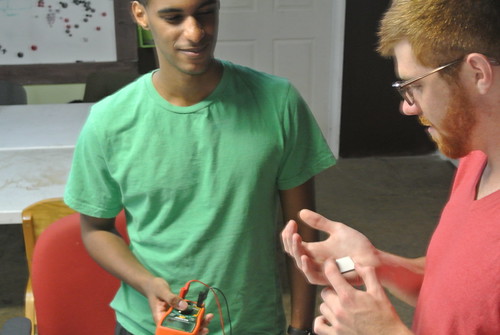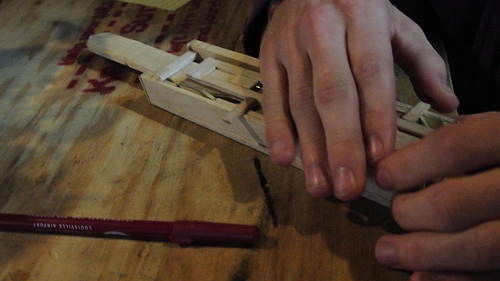
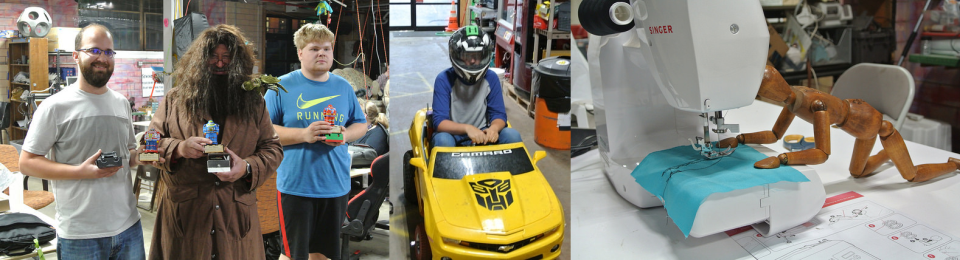
Well hi, my name is Michael Dorsey, a computer engineer student currently doing Co-op at LVL1. Right now, I’m working on two projects relating to gaming, one of them having to do with fusing a game console with a projector to make it “all-in-one,” similar to how people have been also modifying game consoles to become portable.
The other project I’m working is attempting to modify a game controller with the use of a micro-controller. I’m not fully sure how I’m going to go about doing this as I’m still in the middle of research and trying to plan this all out. However, hopefully by the beginning of next month I’ll have made much progress on my work. For now, here are some pictures that reflect the ideas of my projects.


Nothing quite like the satisfaction of having something work just like you wanted. Its true no matter what field you go into. When it comes to making your own game, its something you get every day. I’m a week into mine, just now implementing my game’s (a turn based strategy) combat mechanics, and I can get drawn in. Monday I sat for four hours straight working on converting the basic collision detection between units to implement some damage dealing combat. When I was done though, I was ecstatic. Yes there were still minor bugs, but in the scheme of things, I’d accomplished something.
Civil Engineer student. My project is to replicate and study Structural Health Monitoring systems. (i.e. sensors that monitor the stress and strain of support beams). I don’t have much to show yet; still in research mode. But here is a photo I like, I hope you enjoy.

We have FOUR spring 2013 Makership Co-ops from the Speed School at University of Louisville. In no particular order
the Co-ops & Projects Are:
Nolan Park: Power Wheels regenerative braking system
Eric Cutler: Sensors embedded in buildings and infrastructure
Michael Dorsey: Gaming console with a modified display/controller
Matthew Barnes: A new Java-based game
I wanted to give you all an update to my sensor housings project. With the construction and plumbing issues I was relocated to Dr. Harnett’s lab for a little over a week. Previously it was concluded that we needed to mold the housing in order to reproduce it in a fast and effective manor. Just printing them would take far too much time and produce very unreliable parts. During that time I was able to take advantage of some of the supplies in her lab to start experimenting with molding.
There were three different materials that I tried during this time. One was a paint on mold and the other two required are silicon based rubbers.

The two above were using materials found in Dr. Harnett’s lab. The one on the left pulled away from the part and thus did not make a usable mold. The one on the right, the chemicals were old and questionably usable. It didn’t solidify and eventually I decided to throw it away. I also ordered some fresh material as well as resin for pouring into the mold to make parts.

This mold was actually successful, but also it did a very good job at ‘remembering’ the fine details. With this mold I was able to pour plastic resin in and successfully make a near identical replica.

This shows that this method of production is reasonable in order to produce our housing. The next steps for this are to get a final piece that I will base everything else off of. Also I would like to see how many parts we can do in one mold in order to make production faster.
All the necessary equipment to make reliable solar panels is now set up at LVL1. This includes a custom built oven with a vacuum sealing system capable of making panels up to 15×21 inches, but no worries for bigger projects individual panels can be wired together in series or parallel and with the right framing anything is possible. A further break down of this oven and the panel making process is coming in the future. Along with the oven a tile saw has been set up with a 0.015″ thick diamond blade. This saw can be used to cut scrap or non-scrap of mono or poly crystalline solar cells into usable custom sizes to fit the needs of various projects. The only other equipment needed to make a panel is a soldering iron, which LVL1 has plenty of. Only some materials for making solar panels will be available the rest will need to be purchased. For more info contact Sam Ellis at srelli02@louisville.edu.
The set up:

Example of a solar panel made using the equipment followed by a table of its performance characteristics:


Isc: 0.4485 A
Voc: 16.8 V
PowerMax: 5.1 W
Imax: 0.3845 A
Vmax: 13.28 V
Fill factor: 0.6697
% Efficiency: 12.36%
With the sudden occurrence of the sink hole outside of LVL1 I thought this would be a great time to make my first post updating you all on what I’ve been doing this semester.
I am working with Dr. Harnett on the Salamander Sensor Project. I am developing a water proof housing that will be easier to produce and use than the current one. The entire process of how the current housing is produced is very difficult for the temperature sensors because it can involve a lot of gluing and requires some very precise laser cutting. To eliminate this I have been developing a housing that will be one solid piece with a slit for the temperature sensor to stick out of.
So far this semester I have spent time developing this part with the assistance of LVL1′s Makerbot Cupcake CNC in order to quickly acquire real physical parts from the designs on the computer. I have spent time learning the ins and out of this machine as well ReplicatorG in order to improve the quality of the parts I was producing. At first the parts I was getting were not very consistent in size compared to the models I was making on the computer, but I have managed to figure out different settings that help produce much higher quality parts. With the arrival of the new replicator I hope to be able to produce even better pieces.

Here are some of the parts that I printed using the Cupcake:

As you probably are able to tell just by looking at these two pictures, the Cupcake does not produce the most consistent of parts. Just looking at the region containing the helix there is quite a significant difference between the one on the left and the one on the right.
Co-ops Trent Lowry and Sam Ellis started their LVL1 Co-op Makerships this summer. Stay tuned…


People soldering kits at LVL1 on May 1
Hackerspaces are starting to change engineering education. Let’s put two University of Louisville Co-op interns in the LVL1 hackerspace! We are exploring how to get students working on hands-on projects sooner in the engineering curriculum.
As a Co-op at LVL1, you can contribute to an ongoing project or even launch your own project. The first Co-ops will start in summer 2012. You must be a Speed School student seeking a Summer 2012 Co-op to apply for this program.
If you’re seeking a Co-op position in Fall 2012, Spring 2013 or Summer 2013, stay tuned! There will be another application session for each of those semesters.